How to find YouTubers to sponsor: a guide for brands
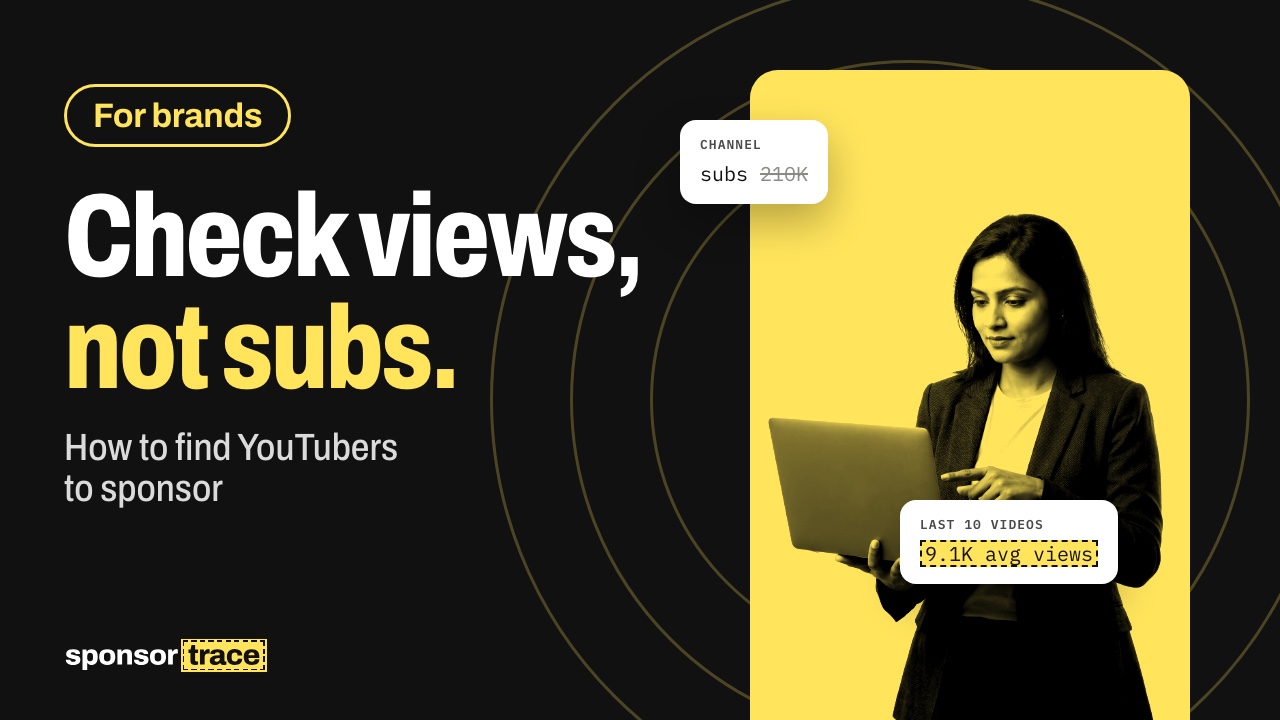
Start with the channels your competitors and category already sponsor, because their audiences have been tested on products like yours. Vet each channel on recent average views (not subscribers), audience country, how often it runs sponsors, recent competitor deals and how it handled past reads. Price from views, test one video with its own code and link, and only then sign a package.
This guide is for brand and agency teams buying YouTube sponsorships: integrations inside a creator's video, and dedicated videos. The process is the same at a $500 test and a $50,000 programme. Only the number of channels changes.
Start with who your category already pays
Every disclosed sponsorship leaves a public record in the video description: the sponsor line, the brand, usually a promo code. That makes your competitors' creator programmes visible to you, and it is the best shortlist you can get. Those channels have shown that their audience responds to products in your category, and that the creator will run a sponsor read.
Repeat pairings are the strongest signal on that list. A brand that books the same channel again is usually seeing results. In our Beauty & Fashion data, about one in three brand and channel pairings ran two or more sponsored videos within six months (videos published 30 Apr to 30 Oct 2026).
A channel that just ran your competitor may be under exclusivity. Ask, and assume a window of 30 to 90 days before it can work with you.
Other ways to build the list
- YouTube search. Search your product category, filter to this month, and note channels whose comments ask about products. Slow, but it finds creators nobody else has booked.
- YouTube Creator Partnerships. YouTube's own marketplace (formerly BrandConnect), bought through Google. It shows creators in the YouTube Partner Program in supported countries, with audience data from YouTube.
- Agencies and talent managers. Faster for larger budgets. You trade price and some choice for speed and handling.
- Creator marketplaces. Good for volume at the small end. Expect many applicants and uneven fit.
- Sponsorship databases. A searchable record of who sponsored whom, and when. SponsorTrace lists every paid sponsorship we found in a niche, with the video and the evidence line, and keeps affiliate links out.
How do you vet a YouTube channel?
Subscriber count is the easiest number to read and the least useful. Channels gain subscribers for years and lose viewers quietly. Use this checklist instead.
| Check | How | Watch for |
|---|---|---|
| Recent average views | Average the last 10 long-form videos. Drop a single viral outlier. | Views under 5% of subscribers on a large channel |
| Audience country | Ask for a YouTube Studio screenshot of top geographies, last 90 days | Most viewers outside the markets you ship to |
| Age and gender | Same Studio screenshot | A mismatch with your buyer |
| Sponsor load | Count sponsored videos in the last 6 months | A sponsor on nearly every video. Reads stop landing. |
| Competitor deals | Read descriptions from the last 90 days | A direct competitor in the last 60 to 90 days |
| Past reads | Watch two sponsored segments | Read word for word, skippable, placed at the very end |
| Comments | Read the last three videos | Generic praise only, no questions, no buying talk |
| Disclosure habits | Look for spoken disclosure and the paid promotion label | Undisclosed deals. That risk becomes yours. |
| Brand safety | Scan titles and thumbnails from 6 to 12 months back | Content you would not want next to your logo |
For context on sponsor load, 7.6% of videos from US Beauty & Fashion channels carried a paid sponsor in our six-month window, and channels with 50K or more subscribers sponsored about 9.5% of their videos. A creator well above that rate is selling a lot of reads to the same viewers.
How much should a brand pay a YouTuber?
Most YouTube sponsorships are a flat fee worked out from expected views: average recent views divided by 1,000, times a rate per 1,000 views. Published planning guides put most niches at $10 to $50 per 1,000 views, and beauty mostly at $15 to $30. Usage rights, exclusivity and rush timelines are priced on top. The full method is in our rates guide.
Be careful with rate cards based on subscribers. Across 1,302 US Beauty & Fashion channels, the median channel with 100K to 1M subscribers got about 9,140 views per video. At $15 to $30 per 1,000 views, that is $137 to $274 per integration, far below the $1,500 to $10,000 that some subscriber-tier tables list. Good channels earn more than the median, but the gap shows why you should price each channel on its own views.
We can show who sponsored whom and when. We never know what was paid, and neither does any other tool that reads public data.
Reach out so creators answer
- Be specific. Name the video of theirs you watched and why their audience fits.
- Lead with the budget or a range. Creators rank offers. A clear number gets a faster, more honest reply.
- Send a one-page brief. See the template below.
- Offer fair terms. Net 30, one revision round, usage for a set period. Creators who know their worth push back on perpetual usage at a content-only price, and the best ones walk away.
- Use a company email domain. Creators are wary of fake brand deals, and an outreach email from a personal address looks like one.
Brand and product: [name], [one line on what it does]
Goal: [awareness / sign-ups / sales], measured by [code + link]
Deliverable: [60–90s] integration, first half of the video, link in the top 3 lines of the description
Must say: [2–3 points, in the creator's own words]
Must not say: [claims you cannot support]
Timeline: draft by [date], publish by [date], one revision round
Usage: organic reposting on our channels for [30] days. Paid usage quoted separately.
Exclusivity: [named competitors] for [30] days from publication
Fee and terms: $[X], net 30 from invoice
Disclosure: spoken in the video, plus YouTube's paid promotion setting
Test, measure, then commit
- Book one video per creator to start, with a unique code and tracked link for each.
- Read results at 7 days and again at 30. YouTube videos keep collecting views for months, unlike most social posts, so an early read understates the result.
- Compare creators on cost per 1,000 views and cost per order or sign-up, not on total views.
- Offer the channels that worked a three-video package. Creators often discount packages, and three placements tell you far more about a channel than one.
Your legal team will also want the disclosure rules. The FTC treats advertisers as responsible for their endorsers' disclosures too.
Common questions
How much should a brand pay a YouTuber?
Work from the channel's recent average views: views divided by 1,000, times $10 to $50 depending on niche, per published planning guides. Add for usage rights, exclusivity and rush timelines. A channel's subscriber count is a poor basis for price.
Are small YouTubers worth sponsoring?
Often, yes. Smaller channels tend to have tighter audiences and cost less per test. Run several small channels in parallel and compare cost per result before scaling.
How many creators should we test first?
Enough to compare: three to five channels with similar audiences, one video each, with separate codes and links.
Should we require script approval?
Approve the key claims and the disclosure, not the wording. Reads that sound like the creator perform better than scripted ones, and creators push back on heavy rewrites.
Sources
Read next
 How to find sponsors for your YouTube channelFour ways to find brands that already pay creators like you, how to tell a paid sponsor from an affiliate link, and how to rank the list you end up with.
 How to negotiate a YouTube sponsorshipGet the brand to name its budget, quote from your views, and when it pushes back, cut what it gets rather than what you charge. With email templates.
 How to disclose a YouTube sponsorship the right wayWhat the FTC expects from YouTubers: where to disclose, what to say, how free products and affiliate links work, and YouTube's paid promotion label.