How to negotiate a YouTube sponsorship
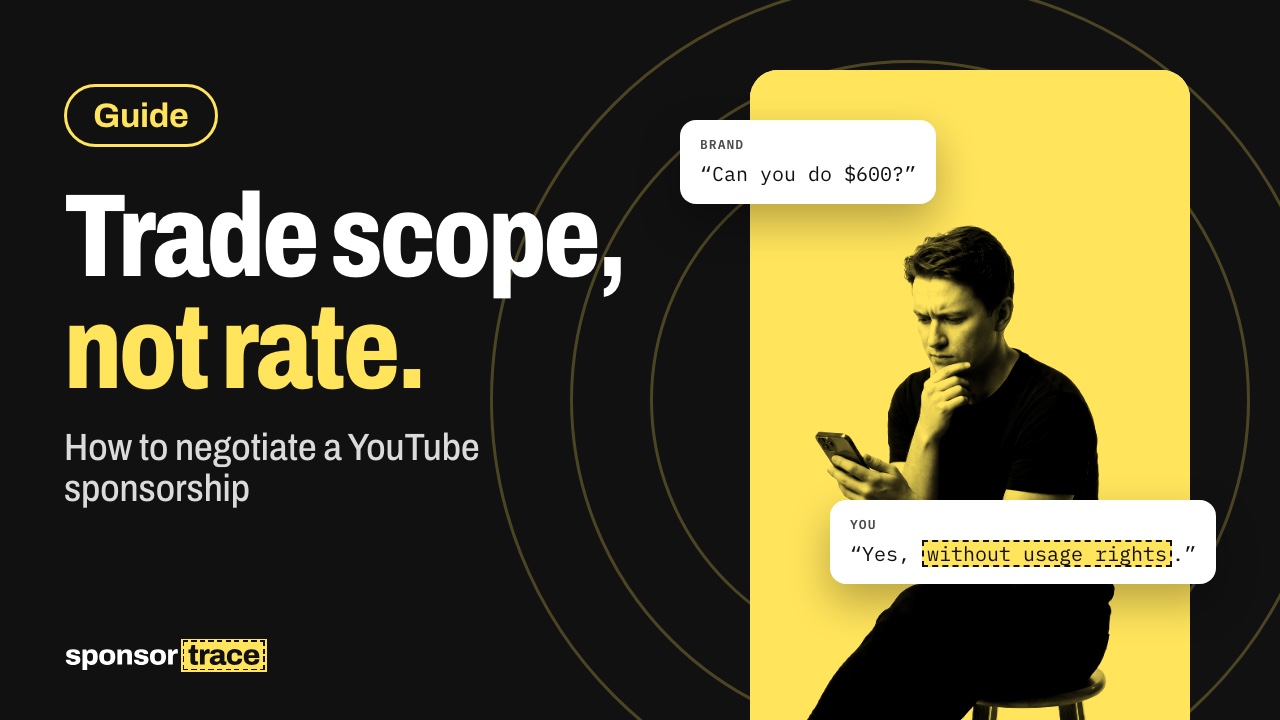
Ask for the brand's budget before you name a price. If you have to go first, quote a range built from your recent views. When the brand pushes back, change what it gets (usage rights, exclusivity, length, deadline) rather than lowering your rate for the same work. Agree every term in writing before you film.
Most creators lose money in a negotiation before it starts, by answering "what are your rates?" with a single number. That number becomes the ceiling, the brand negotiates down from it, and the work it covers is never pinned down. The approach below fixes all three problems.
Work out three numbers before you reply
Start from the formula in our rates guide: your average views across the last 10 long-form videos, divided by 1,000, multiplied by a rate for your niche. Then turn that into three numbers:
- Floor. The lowest fee you would accept for a standard integration. Below this you say no, even if the brand is one you like. It should at least cover your time, including scripting, filming, edits and a revision round.
- Target. The formula at the middle of your niche's range. This is what you expect to close at.
- Opening ask. Your target plus 20% to 30%. Brands expect to negotiate, and almost nobody accepts the first number.
| Example: beauty channel, 20,000 average views | Fee |
|---|---|
| Floor (formula at $15 per 1,000 views) | $300 |
| Target (formula at $22.50) | $450 |
| Opening ask (target + about 25%) | $575 |
Write the three numbers down before the call or the reply. Deciding your floor while a brand manager waits for an answer is how creators end up accepting it.
Should you name your rate first?
Brands almost always have a budget for a campaign, and often a per-creator figure inside it. If you ask, many will tell you, and it is frequently higher than the number you would have quoted. Ask plainly:
Thanks for reaching out. [Product] fits my audience well, and I'd like to make this work.

Before I put a quote together, could you share the budget you've set aside for this campaign, and what you'd like included: format, length, links, timing and how you plan to use the video afterwards?

[Your name]
If the brand insists that you go first, give a range rather than one number, with your target at the bottom of it: "For a 60 to 90 second integration with a description link, I'm usually between $450 and $600." A range shows you have room to talk, while keeping the bottom above your floor.
Find out what they are really buying
A fee only means something next to a list of deliverables. Two offers of $500 can be worth very different amounts once you read what each one includes. Before you quote or accept, get answers to these:
| Question | Why it changes the price |
|---|---|
| Integration or dedicated video? | A full video takes days, not hours. Published guides price it at 1.3x to 1.5x an integration, some at 2x or more. |
| How long, and where in the video? | A 90-second read in the first two minutes is worth more to the brand than 30 seconds at the end. |
| Can they use the clip afterwards? | Usage rights on the brand's own channels or in paid ads are a separate product. Guides suggest 25% to 100% on top. |
| Will they run ads through your channel? | Whitelisting (allowlisting) puts your name on their ads. Price and time-limit it separately. |
| Any exclusivity? | Turning down competitors costs you deals. Guides suggest 25% to 50% on top, and less if the window is short. |
| Script approval and revisions? | Each revision round is unpaid work. One round is a common limit. |
| Deadline? | A rush job pushes other work. Guides suggest 25% to 50% on top. |
| Payment terms? | Net 30 is the usual baseline. Net 60 or 90 is money you are lending them. |
Trade scope, not rate
This is the main idea of this guide. When a brand says your number is too high, do not lower the price of the same work. Lower the amount of work, or remove something they want, so the price for each part stays where it is.
It matters because your rate travels. Brand managers move between companies, agencies compare notes, and the next brand to ask will hear what you charged the last one. A $575 integration sold for $400 sets your rate at $400. A $575 integration sold for $400 with no usage rights and a shorter read leaves your rate at $575, and the brand still got a deal.
| If they say | Offer instead of a discount |
|---|---|
| "Our max is $400." | A 45-second read instead of 90, with no usage rights. |
| "We need it in 10 days." | Your standard fee on your normal timeline, or the rush fee for 10 days. |
| "We want to use it in ads." | Usage for 30 or 90 days at a set price, quoted separately from the content. |
| "We need category exclusivity." | Exclusivity for named competitors, for 30 days from publication, priced on top. |
| "Can you do three videos?" | A package at 10% to 20% off each video, paid per video as each goes live. |
| "We only do affiliate." | A smaller flat fee plus commission, so the cash part covers your time. |
One discount is worth giving freely: the multi-video package. In our Beauty & Fashion data, about one in three brand and channel pairings ran two or more sponsored videos within six months (videos published 30 Apr to 30 Oct 2026). Repeat work costs you less to sell than a new brand does.
Counter-offer templates
Thanks for the offer. At $[their number] I can't do the full scope, but I can make it work if we adjust it:

- A [45]-second integration instead of [90]
- Description link and pinned comment
- No paid usage rights (happy to quote those separately if you need them later)

If you need the full [90]-second read with [30] days of usage, that comes to $[your number].

Which would you prefer?
Thanks for sending this over. I only feature products I've used, so I'd be glad to try [product].

For a sponsored segment, I charge a fee on top of product, as the segment takes [X] hours to script, film and edit. For a [60]-second integration that's $[fee].

If the budget isn't there right now, I'm happy to keep the product with no obligation and revisit a paid campaign later.
Accept a product-only deal only if you would happily make the video anyway, and disclose it either way. Free products count as a material connection under FTC rules. See our disclosure guide.
When should you walk away?
Some offers cost more than they pay. These are the ones to turn down or push back on hard:
- Usage "in perpetuity" at a content-only price. You would be giving away an ad you can never take back.
- Guaranteed views or sales. You control the content, not the algorithm or the checkout page.
- Category-wide exclusivity for months, for one video. "No beauty brands for six months" can cost you more than the deal pays.
- Net 90, or payment "on performance". Long waits are a risk with any brand, and more so with one you have not worked with.
- Any request to hide the sponsorship. It breaks YouTube's policy and the FTC's guidance, and it puts your channel at risk, not theirs.
- A fee, a sign-in, or software to install before work starts. That is not a negotiation. See how to check whether an offer is real.
Close it in writing
Calls are good for building a relationship and bad for settling terms. After any call, send a short email that lists what you agreed: deliverables, fee, deadline, revision rounds, usage, exclusivity and payment terms. Ask the brand to confirm it. That email is your fallback if a contract never arrives, and your checklist when it does. Our contract guide covers the clauses to read closely.
Raise your rate the right way
- After a result. Send the brand its views, clicks and code uses at 7 and 30 days. If it worked, the renewal is the natural point to quote higher.
- When your averages move. If your last 10 videos average 30% more than when you set your rate, update it for new brands straight away.
- With notice for existing partners. Tell repeat sponsors one campaign ahead. Most will accept a fair increase from a creator who delivers.
Not sure who to negotiate with yet? Start with brands that already sponsor channels like yours.
Common questions
Should I negotiate my first sponsorship?
Yes, at least on scope. Asking about budget, deliverables and usage is normal and makes you look professional. You can accept a modest fee on a first deal while still keeping usage rights and exclusivity out of it.
Is it rude to counter a brand's offer?
No. Brand managers expect it, and many open below their budget. A polite counter that changes the scope rarely ends a deal.
What if the brand says the rate is fixed?
Then negotiate the terms around it: usage, exclusivity, deadline, revisions and payment timing. If the fee is below your floor even with a smaller scope, decline politely and leave the door open.
Should I take a lower fee plus affiliate commission?
It can work when you trust the product and your audience buys through links, but make sure the flat fee alone covers your time. Commission is a bonus, not a guarantee.
Sources
Read next
 How to find YouTubers to sponsor: a guide for brandsFor brands and agencies: find creators your category already pays, vet them on views, audience and sponsor history, and price and test the first deal.
 How to find sponsors for your YouTube channelFour ways to find brands that already pay creators like you, how to tell a paid sponsor from an affiliate link, and how to rank the list you end up with.
 How to disclose a YouTube sponsorship the right wayWhat the FTC expects from YouTubers: where to disclose, what to say, how free products and affiliate links work, and YouTube's paid promotion label.